On the evening of December 21, 1957, the Primary children presented a play at the Aurora Branch Christmas party. Back row: Erek Erekson, Cathy Sullivan, [unidentified], [unidentified], John Ottinger, [unidentified], Julia Woolcott, Rose Marie Resch (behind curtain). Front row: [unidenified, possibly Tommy Spahr, [unidentified], Bucky Spahr (Earl Spahr Jr.), Billy Spahr, John Swords, Sandy Hill. Front right: Cris Erekson.
As recorded in the Primary History scrapbook, the skit depicted "sharing with those less fortunate" and was followed by the younger classes who "sang songs and said poems." New in this photo are: Paul Doty, [unidentified], Cris Erekson, [unidentified, possibly Margie Reynolds], Margaret Sullivan. David Swords in standing in the center. The backdrop had been painted on the basement wall by Mary Jane Greer.
To the delight of all the children, Santa Claus visited the party later and distributed gifts and stockings. Jim Greer may have been the one to play Santa that evening because playing Santa was one of his favorite holiday activities. (For more about this go to the posts for December 2009.) But by this time most people expected him to be the one in costume, so as a joke he sometimes asked other men play the part. One of the funniest Santas was the very tall, very thin Bill Kettley.
The M.I.A. served refreshments that evening and the adults exchanged grab bag gifts. (That means they brought small gifts in decorated paper bags, put the bags in a pile and grabbed.)
Two other Christmas parties are also recorded in the Aurora Branch Primary History scrapbook. They seem to follow a pattern:
December 17, 1955:
"The Primary, along with other groups of the Church held a Christmas party on this date. Games were played which everyone enjoyed. Christmas tree ornaments made by the group that attended were hung on the tree. Santa Claus made his appearance with gifts for all the children and parents. Refreshments were served later in the evening."
December 4, 1956:
"The Primary held a Bake Sale on this day. The money was used to buy Christmas gifts and candy for the Christmas party. The Christmas party was held at the Greer home. All groups of the Church held a combined party."
Tuesday, December 20, 2011
A Christmas Party in 1957

Wednesday, October 5, 2011
The Ghost of Sundays Past: The Odd Fellows Hall Revisited
When I was in Aurora to attend my high school reunion last July, Ed and Sharon Kettley took me to see the Odd Fellows Hall. It’s still for sale, and the price is now only $449,000 (Price reduced by $126,000—aren’t you glad you didn’t buy it two years ago?). Ed, who is the owner of the successful Kettley Realty in Aurora, arranged with the listing agent to let us walk through the old building. What a trip down memory lane!
 So, is anything the same after fifty-one years?
The stairs are still there! Now nicely carpeted, they still lead forever upward. I counted fourteen stairs to the landing and then another twelve to arrive at the second floor where the branch met during most of the 1950s. (There are so many steps because of the high ceilings of the commercial spaces on the ground floor.)  This picture of Louise Erekson, standing in front of the open door of the Odd Fellows Hall, ca. 1955, reveals the wooden—uncarpeted—steps and the dimly lit stairway. (Disclaimer: I'm not responsible for the 'artsy' angle of this photo.)
The long, steep steps provided a weekly trial for older folks who sometimes had to use the handrail to pull themselves up hand-over-hand. The original handrails are still in place, as are some of the paneled oak doors and hardware.
Throughout the 1950s the branch held Sunday school, sacrament meeting, and potluck dinners in the large second-floor hall on the north side of the building. We measured the room and found it to be 75 feet long and 20 to 23 feet wide. The photo below, taken during a 1959 Primary program, looks toward the windows on the west side of the room. Taken on the same occasion in 1959, the photo below clearly shows the length of the room.
Still as long as ever, here's what the room looks like today (2011). The desks are left from a tutoring service that recently rented this second floor space.
Going up to the third floor means climbing another twenty-three steps. The branch met on this level before moving down to the second floor. In the late 1950s, however, the children of the Junior Sunday School climbed the second set of stairs to meet in the third-floor room at the front of the building. We were told that in recent years the rooms on the third floor were rented by a “Swingles Club.” (Don’t ask what that is!)
 The large ceremonial room at the back of the building was off limits to children when the branch met at the Odd Fellows Hall. The doors still have the peep holes and covers used by lodge members to gain entrance to restricted meetings.
For twenty-five years (from about 1935 to 1960) members of the Aurora Branch crossed this threshold into the Odd Fellows Hall. The original tiles are still in place. “I.O.O.F” stands for “Independent Order of Odd Fellows.”
It was exciting to enter this amazing place after so many years. Again I express my appreciation to Ed and Sharon Kettley for arranging the visit to the Odd Fellows Hall. Ed and Sharon Kettley at the main office of Kettley Realty, Aurora, Illinois
The Odd Fellows Hall will celebrate its 100th birthday in 2012. The past fifty-one years have not been especially kind to the building, but it deserves to be memorialized for its role as home to the Aurora Branch.
For the next post, I will try to recreate a floor plan.
Tuesday, August 16, 2011
The First Seminary in Aurora Branch
By the fall of 1963 Aurora Branch had enough high school students to establish an early-morning seminary class. Deanna Lyman Greer, who held a teaching degree, was called to be the first seminary teacher. She converted a small bedroom in her home on Elmwood Drive into a classroom, and students gathered there at 6:00 a.m. each morning.
For the next school year, seminary moved to the home of Fred and Jean Smith. This photo was taken on their porch in the fall of 1964.
 Front: Deanna Greer (teacher), Bethine Mindar, Rose Marie Resch, Linda Hill, Julia Woolcott. Back: Erek Erekson, Ren Smith, Jerry Rod, Earl Spahr Jr., Tom Erekson.
Recalling seminary, Deanna Greer said, “I really enjoyed teaching seminary. The first year it was Old Testament and I learned so much. I was impressed at how faithful the kids were.
“When we were meeting at my house, my son Tom would crawl in and sit under the roll-around blackboard we had placed in the room. My first daughter, Janeen, was born in May 1964, on the day of seminary graduation. They called her the seminary baby.”
The second year course of study was the New Testament. Deanna continued to teach until March of 1965 when she was released due to complications of pregnancy. Bob Erekson, recently released as branch president, was called to finish out the year as seminary teacher.
Seminary was established in September 1963 because the Chicago South Stake was moving forward on a stake level to set up seminary classes in all wards and branches. Deanna Greer worked under a stake CES (Church Education System) director, with Bob Erekson as branch president.
Monday, April 4, 2011
1933 Was a Very Good Year

Myrtle Greer kept a diary for part of 1933. Although the entries are fragmentary, they provide a clear snapshot of her life three and a half years after the family settled in Aurora. By this time they were living in the house at 710 North Harrison where they would stay for almost eighteen years. Her husband, Jim Greer, was starting to fix it up. Her diary records that on June 24 he “raised home to put basement in.” No one knows where he found the time to hand-dig the basement, but he did—and poured his own concrete blocks for the walls too. He was working full time at Lyon Metal, and sometimes half-days on Saturday, as well as gardening and milking the cow, and taking care of the branch.
The Greers' lives already revolved around their work in the branch. More than half of the 101 diary entries mention missionaries and Church activities. Adding in the entries that mention members’ names without a specific reference to a Church activity increases the percentage. Jim had been ordained an elder in 1932 and was set apart as the Sunday School superintendent. Much of the time Jim and Myrtle were feeding missionaries, driving them to meetings, and keeping them overnight.
In her autobiography, Myrtle recalls: “If the missionaries were hungry, they could always come here and get a meal. Just like that Elder said, it was a depression. Everybody was out of food, but when he came to the Greers’, they always had something on the table to eat, and the missionaries was always invited. We used to keep the missionaries so much” (The Story of Jim and Myrtle Greer: Family and Church, 45).
How did they do it? Myrtle goes on to say: “We generally had some canned stuff that I’d canned the summer before, and we’d open some of that. We bought day-old bread and brought it home and shared it with the missionaries and the neighbors. If it was summertime, we just took out of the garden. Later on, we had a strawberry patch. We had lettuce, radishes, onions, all that stuff in the garden. We also had an apple tree and a cherry tree” (The Story of Jim and Myrtle Greer: Family and Church, 45-46). She was also raising chickens.  One of the elders who visited several times in early 1933 was President S. Laurance Moss. Like more than 160 other missionaries, he left his photograph printed on a postcard. The Greers kept all of the portrait cards, as well as the Articles of Faith calling cards, and these now form part of the Aurora Branch History Project collection. In the 1930s the missionaries usually took the time to write a note of gratitude and friendship on the back.
In an interview in July 2009, Jimmie Greer recalled this story: “Elder Moss was the district president. He would come and visit the branch from time to time. My dad always had a cow and one time it was about to calve. Dad would say, ‘I wish Elder Moss could come by and sing to my old cow so she’ll have her calf.’
“They tell me when Elder Moss came and he was sitting up in front, that right during the meeting, I went up to him, sat on his lap, and put my hands on his cheeks and said, ‘Elder Moss, will you come out to our house and sing to our cow so she’ll have her calf.’" 
In her story, Myrtle says, “We got Jimmie back as quick as we could, got him on his chair, and sit him down. So Elder Moss come out, but the old cow had already had her calf. He didn’t have to sing” (55). Myrtle's diary records the birth of a calf. It might be the one in question: “Tuesday, May 30, 1933: Little Jimmie Birthday [6 years old] / had picnic at park / Old Rose had a calf / name it Esther Mae / we make ice cream.”
Elder Moss was from Woods Cross, Utah. The family visited him and had dinner with his family in 1941 when they were in Utah. He was later the livestock and grain commodities announcer on KSL in Salt Lake City.
The blog is going to continue our look at the contributions of missionaries who served in Aurora.
Monday, March 28, 2011
Bob Erekson's Beginnings in Aurora Branch
When cleaning my father's office after his passing, I found among his papers a typescript of his life story from 1935 to June 22, 1942. The excerpt included below contains references to the Aurora Branch after meeting the Greer family in May 1941. These stories show how different the Aurora Branch was from his church-related experiences in what he calls "the valley of the mountains." The photo on the right shows a young, green Bob Erekson in June 1940 on the day he left Utah to enlist in the Army Air Corps at Chanute Field in Rantoul, Illinois. About a year later, he decided to look up the Church. On the weekend of May 17, 1941, he hitched a ride to Chicago and found out to his surprise that quarterly stake conference was being held. He was introduced to the Greer family and promised to visit them the next weekend. He paid some friends fifty cents to take him to Aurora. Here is Bob's story:
"Sunday morning I got up and went to Sunday School with the Greers. It was very nice to be back in Church once again, helping with the Sacrament and all the rest of the work I could do. Mr. Greer was having some trouble with his back, and Louise had to work that afternoon, so we took her to work but found that she didn’t have to go to work until 3:00 p.m. So Mr. Greer went to the doctor and I took Louise for a drive in Mr. Greer’s ’36 Buick...After that I went back to the doctor’s office.
"That night I went to Sacrament Meeting. It was a very wonderful meeting and after it was over I helped a Mr. [John E.] Whowell from Chicago and Mr. [John] Wendt of Aurora administer to Mr. Greer so his back would bet well. It was the first time I ever did anything like that since I had been made an Elder nearly a year ago, just before I joined the Air Corps.
"After the meeting was over I went back to the Greers, changed back to my uniform, after which Mr. Greer drove me out of Aurora about seven miles and I began hitch-hiking...
As you see, the new experiences began immediately: administering to the sick, bearing his testimony, giving talks, sightseeing in Nauvoo, and attending General Conference. He was needed in Aurora. Best of all, he found that he loved his new-found Church activity. Knowing that Louise was there kept his enthusiasm high. This photo was taken on his first weekend in Aurora.
"[Four days later] Thursday afternoon at three p.m. I took off for Aurora on my thumb. I got there at seven p.m. Central Daylight Time.
"I took my coveralls and as soon as I got there I changed to them and helped Jimmy mow the lawn…Sunday I went to Sunday School and Testimony meeting. One thing about testimony meetings in Aurora different from those back home, is that every person in Aurora got up and bore his or her testimony. So I bore my first testimony. That evening was conjoint or mutual night, and so the young people took care of the program. I gave a talk and all of the others did something...
"[The next week] Louise had to take care of some children so she brought them to Sunday School and in the afternoon while Mr. and Mrs. Greer went to Chicago, Louise, Jimmy, Mary Jane, the Kids, and I went on a picnic in Philips Park, Aurora…At 6:00 p.m. Mr. and Mrs. Greer came for us and later we went to church. The speaker from Chicago didn’t show up, so they asked me to talk. After that I drove the Greers home and then Mr. and Mrs. Schleifer took me out to the junction from where I hitched back to the field....
"During the month of June I bought myself a 1936 Buick four door sedan. On the fourth of July the Greer family went to Nauvoo and Carthage. They took me along and it was a trip that I will never forget.
"Sunday July 6, 1941 I had to talk in church and because of the lack of speakers Louise and I sang “Truth Reflects Upon Our Senses.”...
"[September] Among other things was Quarterly Conference for the Chicago stake at Milwaukee. From the General Board there was Harold B. Lee of the Twelve. I never really enjoyed a conference until I heard him talk. It seemed to me that he was talking just to me, almost as if he knew my every question and thought...
[A trip to General Conference] "So I left the Field at about noon Tuesday September 30, 1941 and drove to Aurora where I picked [up] the entire Greer family and we started into the setting sun which was one of the most beautiful sunsets I have ever seen since I came East...
"Later I drove to McCraney’s where the Greers were to stay during their visit in the valley of the mountains. After going to a session of General Conference I went home to Payson, Utah, a drive of about sixty-five miles. …The next day I took Mother to S.L. where we attended the afternoon session of the General Conference for that day. This was the first time I had ever been in the Tabernacle. It is really a thrill to be on the inside of such a beautiful building...
"The next day Saturday October 3, 1941 I picked up the Greer Family and took them to Spanish Fork a small town about six miles from Payson. There I left the Greers with one of the Missionaries, who had visited them when he was on a mission in the Northern States Mission..."
Sunday, January 23, 2011
In Memorium, Robert L. Erekson 1921-2010

Bob Erekson, Aurora Branch president from 1961 to 1965, passed away at his home in Billings, Montana, on the morning of December 27, 2010. He was 89 years old. He is survived by his wife, Louise G. Erekson; and their ten children, Ginger (Bill) Hamer, Tom (Terry), Erek (Lenore), Cris, Douglas, Randall, Jay (Susana), Matt, Jon (Jennifer), and Jared; 36 grandchildren and 27 great-grandchildren.
In August 1961 Bob Erekson was called by Chicago Stake President John K. Edmunds to replace his father-in-law James T. Greer, who had served as branch president for some twenty-eight years. His new counselors were Robert H. Ross and Donald A. Mindar with William E. Kettley as branch clerk, as shown below in this clipping from the Aurora Beacon-News.  After a year and a half Bob Ross moved back to Pennsylvania, Bill Kettley became a counselor, and Dean Meyer was called as the branch clerk. Later, Dale Fisher replaced Donald Mindar as a counselor.
The branch had been meeting in the Seventh Day Adventist church on Plum Street for about a year and a half, but on the day of his call, Erekson was informed that the branch had to find a new place to meet. "After much prayer," he later wrote, "I received that answer that we were to rent the old Christian Science chapel. We had complete use of the building for more than a year until it was sold."  The branch next met for a brief time at Lincoln Elementary School on South River Street in Aurora and later moved to Allen School on the east side.
Erekson relished one of the blessings of being branch president—the opportunity to attend General Conference twice a year, with travel expenses paid for by the Church. Here he is shown in 1962 on the BYU campus where he was visiting his daughter on his semi-annual trip to Utah.
Under Erekson's leadership the branch continued to grow. By November 1962 there were 242 members. In February 1963 the branch became part of the Chicago South Stake, with Lysle R. Cahoon as president, and John Sonnenberg and Dallin H. Oaks as counselors. The members kept working feverishly to raise money for the building fund, but the dream of having a chapel in Aurora was postponed when President Cahoon invited the Aurora Branch to be one of the units to occupy the new stake center that was to be built in Naperville. At that time, local wards and branches has to raise forty percent of the funds for construction, and so members of the Aurora Branch were assessed large sums of money. They built additional building fund houses and completed many other fund-raising projects.
Unfortunately, the three and a half years that Bob Erekson served as branch president were marked by contention and division among the members. A strong faction remained loyal to President Greer, and he did nothing to discourage their dissension. President Cahoon, shown above on the left, was supportive of Erekson and was understanding of the difficulties involved.
Upon his release on February 21, 1965, Bob Erekson wrote: "I am very happy with life and am well satisfied with the knowledge and blessing Father in Heaven has given me. I have had several spiritual experiences that have helped me to know that the Church of Jesus Christ of Latter-day Saints is true."
In 1968 the Ereksons moved to Billings, Montana, where Bob changed from building homes to building custom-designed slip-in campers and toppers for pickup trucks.  When he retired in 1989, he devoted much of his time to genealogy and published several family histories, the largest being a record of the Choate family in southern Illinois. In order to do this he became expert at using genealogy programs on the computer. He was also active in the Yellowstone Genealogy Forum and taught numerous classes in how to use the computer for genealogy.
Bob Erekson served actively in the Church for the rest of his life. From 1973 to 1985 he was a counselor in the Billings Montana Mission. He worked in the Billings Temple for eight years and for the past twelve or more years served as the membership clerk for his ward, updating the records one last time a few days before his death. He will be missed by friends and family.
Please add your memories of Bob Erekson as comments to this post or email me, his daughter, and I will post them for you.
Sunday, November 21, 2010
Developing Local Leadership
Based on a paper presented at the John Whitmer History Association conference, Rockford, Illinois, September 24, 2010: “LDS Outpost in the Mission Field: The Old Aurora Branch (1932-1965)”
Around the turn of the twentieth century Church leaders began encouraging members to stay where they were and not “gather” to Utah. Members were to begin building up the Church in their own hometowns, far away from the intermountain West. In some larger cities, like Chicago, the new approach worked reasonably well and a core of strong leaders emerged, who were largely transplants from Utah. But for some forty years, members in the small, outlying branches struggled with sparse numbers, long distances, and lack of experience.
The Aurora Branch provides an excellent case study of how the local leadership was gradually developed. When the Greers arrived in Aurora, missionaries presided over all of the meetings. Elders who grew up in Utah simply had more experience in the Church than the new converts in Illinois. They even presided over the Relief Society. Batavia Branch Relief Society, late 1930s
Minutes of the Relief Society meeting held October 2, 1928, record the testimony of Elder Bertrand Beck, a new missionary. “I did not know nor do not yet know much about Relief Society work but I do know it is the work of the Lord. I know that Joseph Smith was a true prophet of God and that Jesus is the true Son of God. Ask all the favors and blessings in the name of Jesus Christ, Amen” (LDS Church History Library, microfilm LR2975, Box 1:12, 14, RS minutes 1928-31). Missionaries also collected and recorded tithing donations and performed baptisms.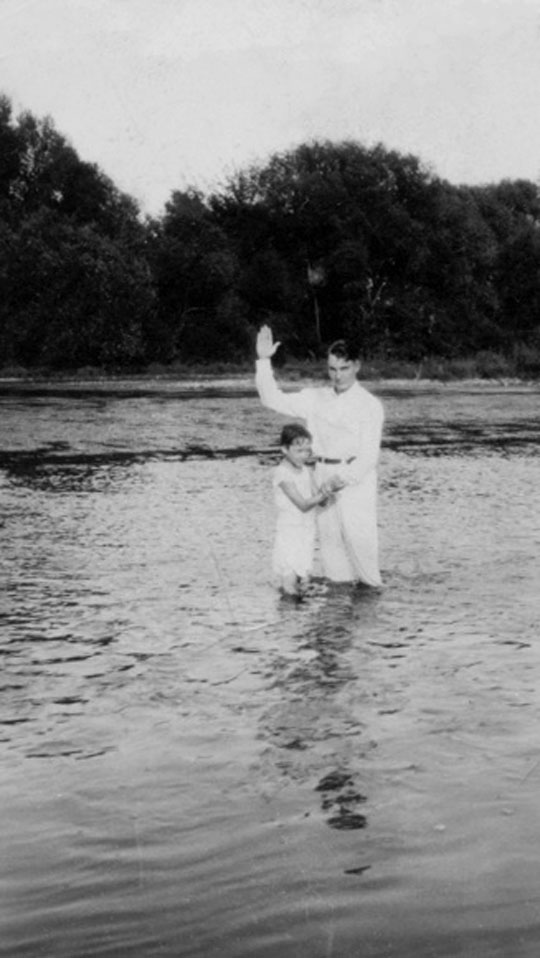 It is interesting to note that James T. Greer did not baptize his daughter Louise in September 1932. Elder Elsworth P. Romney took care of that. (Photo left.) Yet by 1939, there are many stories of his exercising his priesthood and gift of healing. What happened in those brief seven years to cause such a change?
First of all, Jim Greer showed up and kept showing up. Thus he was present to be tutored by missionaries, mission presidents, stake presidents, and General Authorities. Visitors from Salt Lake City attended mission and quarterly stake conferences, and Jim and Myrtle Greer were always there. For example, in 1933 both George Albert Smith and David O. McKay, counselors in the First Presidency and later presidents of the Church, presided and spoke at a mission conference. In 1936 President Heber J. Grant organized the Chicago Stake.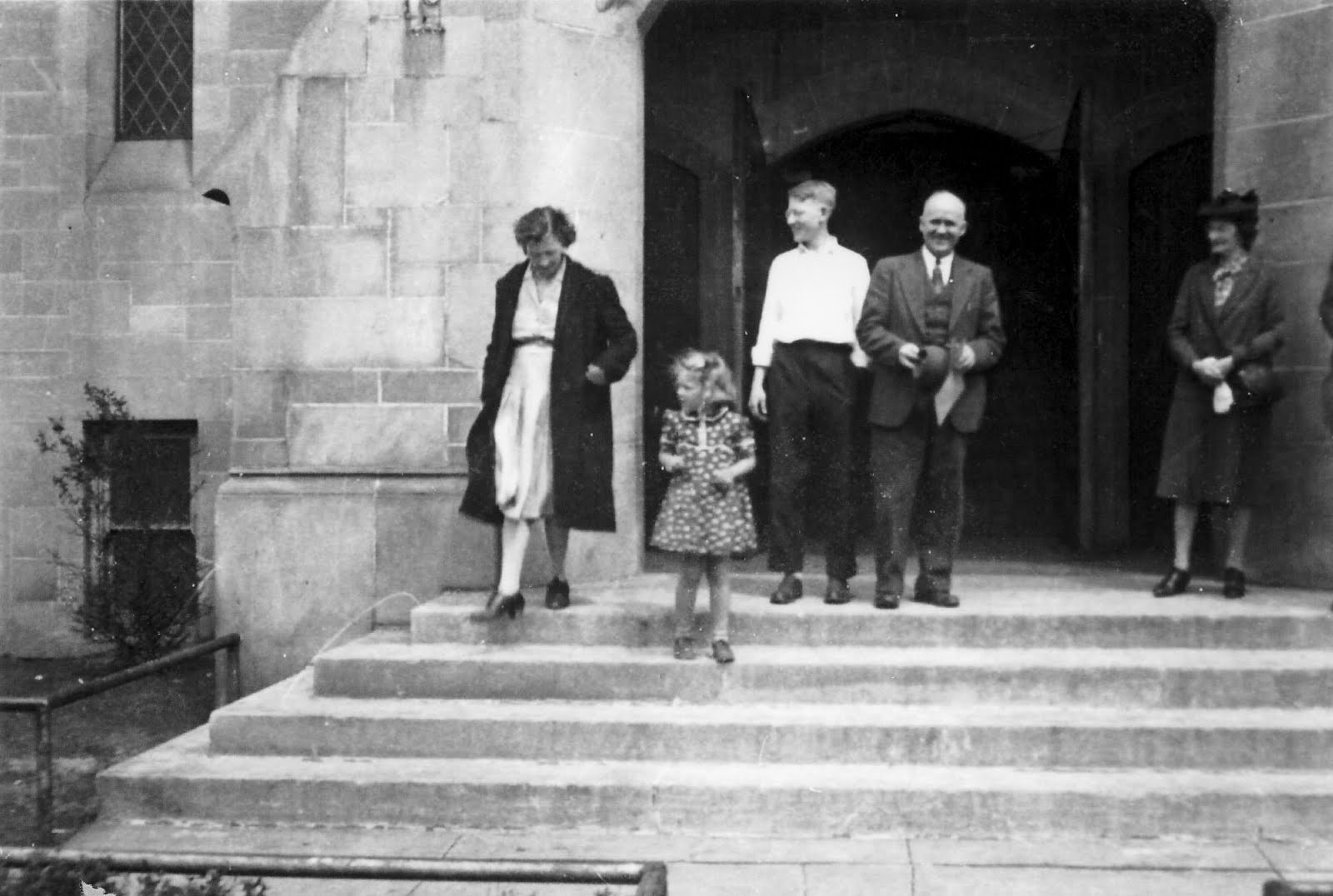 (Right) The Greer family after stake conference held at University Ward in Chicago, ca. 1941
According to his son-in-law Bob Erekson, Jim Greer remembered everything he heard. So in spite of being barely literate at first—having only a few months of education in a country school in southern Illinois—Jim Greer was able to learn quickly. He apparently applied himself to study. With the help of Myrtle, who had an eighth grade education and a teaching certificate, he gradually improved his reading skills. In 1934 she gave him a copy of Jesus the Christ by James E. Talmage, a formidable volume (now in possession of Ginger Hamer). Whether he read the book himself or she read it to him is not known, but Jim learned to read well enough to read Church instruction manuals and everything else that was needed.
He also learned by doing. He was called by the missionaries to conduct the Aurora Branch Sunday School in April 1932. He also conducted the evening meeting for the first time on May 22, 1932. (Left) James T. Greer, flanked by two young women in the branch and two elders, ca. 1936. Note the sign: "No collections" being the main attraction to the meetings.
James T. Greer gradually gained confidence and grew in his calling, yet even into the late 1950s, his style of conducting meetings was casual, “down-home,” and entirely his own.
During the 1930s the Aurora Branch remained painfully small, and when Robert L. Erekson arrived in 1941, the membership still consisted of fewer than fifteen people. The Lord took time to build a leader first, and when the branch began to flourish, he was ready.
Back Again
From May 10 to November 21 is a long time to be silent. I apologize for the long hiatus. I'm back again now and hope to continue this research and reporting more regularly.
At the end of May we took the first steps to move from the house where we had lived for thirty years.  We were blessed with a quick sale and with a new home that suits us perfectly for now, and hopefully for a long time. We still have boxes to unpack, but we are mostly settled, and I can turn my attention back to this project that is so dear to my heart.
I am still convinced of the importance of gathering the history of the Aurora Branch. I encourage you to send photos and stories to my email address: gingerhamer@yahoo.com.
Thanks!
Monday, May 10, 2010
Attendance Record 1945
The Aurora Branch set an attendance record in 1945, as recorded by Myrtle Greer in the Branch History.
John K. Edmunds was the main speaker. Others attending were Henry A. Matis, Ariel Williams, John Whowell. John K. Edmunds was in charge. [page 59]
Louise Erekson saved a copy of the printed program from that meeting.
 Notice the discrepancy in the dates. We might guess that the meeting, originally scheduled for April 29, was postponed until June 31.
You have to give the branch credit for creative missionary efforts and for trying to put their best foot forward. They invited all the members of the Odd Fellows lodge as well as friends and neighbors. We assume that the meeting was held in the lodge room on the third floor of the Odd Fellows Hall because 200 people would not have fit in the long, narrow room on the second floor where meetings were usually held.
To give an idea of how unusual it was to have so many people in attendance, Bob Erekson says that when he arrived in Aurora in 1941, there were only 16 active members. The next attendance record was set in 1957 or 1958 on an Easter Sunday when attendance topped 100. I remember the occasion because I was serving as Sunday School secretary and I was responsible for counting everyone.
In 1938, twenty years earlier, sacrament meeting attendance averaged 9.6 people, and Sunday School a little better with 15.4, as recorded in the first entry of the History of the Aurora Branch, beginning January 1, 1938:
We have 23 members and are holding our meeting in the I.O.O.F. Hall 62 South LaSalle St., pay fifteen dollars a month rent.
In the month of January we held 5 sacrament meetings, 48 total attendance
5 Sunday School, 77 total present
2 Genealogy, 11 total present
Mutual [no numbers listed]
Visitors from Chicago during the month High councilman Ronald Molan [sp?], Henry Matis, Golden Driggs, also Conrad Sorensen
Today we know these early members were laying a strong foundation. Yet it is amazing to think of the faith that kept them coming week after week. Their dedication and willingness to make things happen can be seen in the following list of officers sustained at a branch conference on September 18, 1938. Ten people were filling 19 callings.
James T. Greer, pres of Branch
John Wendt, 1st counselor
Myrtle Greer, branch clerk
Kathryn Arbuckle, chorister
Louise Greer, pianist
James T. Greer, supt. of Sunday School
John Wendt, asst. supt.
Myrtle Greer, sec & Treas
John Wendt, pres of MIA
James Greer, 1st counselor
Kathryn Arbuckle, 2nd counselor
Mable Wendt, sec and treasurer
Mable E. Wendt, pres of Relief Society
Alice Minnehan, 1st counselor
Myrtle Greer, 2nd counselor
Alodia Howard, sec and treas
Alodia Howard, chairman of genealogy
Evelyn Kettley, sec
Lyle Kettley, teacher
[The historical records cited here were found at the Church History Library, microfilm call# LR2975 14, Reel #1-11, 14, 15, 16, 17, 18. Program in possession of Ginger Hamer.]
Thursday, April 22, 2010
Announcing the Aurora Branch History Project
This blog is almost one year old—it began on May 13, 2009—and with its first anniversary comes new focus.
The project that started as a personal journey has taken on a more formal purpose and an official name—Aurora Branch History Project. Soon it will also have a logo that will most likely include this photo of branch members posing in front of the entrance to the Odd Fellows Hall in 1948, near the mid-point of branch history.  Front, l to r: Ardis McCarty, Nancy McCarty, Louise Williams (visitor from Chicago), James T. Greer holding grandson Tom Erekson, Myrtle Greer, Cora Hall, Grace Erekson (visiting from Utah), and Ilda Fuller. Back row: Louise Erekson, Jimmie Greer, Mary Jane Greer, and Patty Ward.
Although I have not posted to the blog in more than six weeks, I assure you that during this time I have spent more hours than ever on research and the organization of research files. I thank all of you for your patience with the unexplained hiatus.
This new emphasis began with a research trip to the Church History Library in Salt Lake City where I spent four days in early March reviewing microfilms about the Aurora Branch and transcribing minutes of meetings held during the 1920s, 30s, and 40s. While there, I met one afternoon with a senior staff member of the Joseph Smith Papers Project, who is an acquaintance of my son John Hamer. He encouraged me to continue this project, pointing out the need for research on the Church in the mid-20th century. Very little has been done on this time period, and even less has been compiled about the history of the Church in the branches of the Midwest. (Perhaps the experience we share and the information being gathered will be more far-reaching than we had imagined.)
Also in the past few weeks I have designed a standard form for cataloging the information that I am compiling on each member. I’m sure the form will be modified going forward, but for now it contains time and place of residence in Aurora, occupation, some genealogical information and names of family members, activity in the branch, photos, commentary, current contact information (for the member or descendant), and a list of resources consulted. This standardization has already been a great help in organizing my somewhat haphazard files.
I renew my request for you to share photos, anecdotes, and genealogical information about the Aurora Branch, and I emphasize that the branch members and their descendants may request copies of my files at any time.
Preserving and sharing information always has been ultimate goal for compiling this history. There will undoubtedly be many ways to share the information over time. For instance, this coming September I will be presenting a paper relating to the Aurora Branch at a conference of the Community of Christ Church (Reorganized LDS) in Rockford, Illinois.
Eventually all the research materials and the Aurora Branch artifacts that I inherited from my grandparents will be donated to the Church History Archives in Salt Lake City.
I look forward to continuing this journey through history and I invite you to accompany me as we get to know the fine people who were dedicated members of the Aurora Branch.
Thursday, March 4, 2010
Primary Remembered
“The Primary’s the main organization in the Church,” Myrtle Greer explains in her oral biography. “You teach children when they’re little, and they’ll stay with it and make good members. I did love Primary. About all I knew was missionary work and Primary.”
For many years after she invited neighborhood children to her home for Primary, those same children would greet her on the street as adults. She and Jim would be coming out of a store downtown and someone would come up to them and say, “Oh, we used to come to your house for Primary.”
Myrtle continues: “They met here at my house until they got to where they had to have a class in the bathroom. When they did that, I told Jim, ‘This is it. I cannot keep them any longer.’ We had to get another place.”
Here are two photos of the children and teachers in 1956-57, about the time the Greer home was reaching its limit. Notice the smaller children are on benches that someone in the branch made so that as many children as possible could crowd together.
Above, Primary children and teachers, 1956-57: front, Margaret Sullivan, Ginger Erekson holding Craig Boswell, [boy with head turned], Margie Reynolds(?), Steven Doty, Cris Erekson, Vera Resch. Second row: [girl behind Ginger’s head, probably a Boswell], Cathy Sullivan, Kathleen McGuire holding Ann McGuire, Paul Doty, Rose Marie Resch holding Dottie Sullivan(?). Third row: Myrtle Greer, Erek Erekson, Tommy Spahr, [boy], [girl]. Fourth row: Bucky Spahr (with back turned), Billy Spahr (hidden), [boy], Tom Erekson, John Resch.
In the picture below, most people are seated in the same location, and because the pictures were taken from different angles, we are able to identify more of the children. In addition, Gladys Sullivan is now seated to the left of Myrtle Greer.

When special Primary activities were held at the Greer home, Jim and Myrtle became “guests.” Here are photos of two consecutive Daddy-Daughter dinners, 1958 and 1959.  Seated around the dining room table in 1958, clockwise from the front left corner: Cheryl Swords, Chuck Swords, Earl Spahr, Rose Marie Resch, Fred Woolcott, Julia Woolcott, William and Anita Aymar.
 February 28, 1959: [Mr.] and Joan Wilbershied; Earl Spahr and Rose Marie Resch; Charles and Cheryl Swords; Bill and Anita Aymar; Fred and Julia Woolcott.
From the Primary History: “The Seagull and the Lark classes held their “Daddie Date” on this evening. Sr. Rosalee Spahr and Sr. Lee Fisher, teachers, along with the girls planned the evening. Games were played and music sung throughout the evening. Br. James T. Greer, president of the Aurora Branch, and Sister Myrtle Greer were guests. Delicious refreshments were served from a beautifully decorated table. Colors of red and white were used. Br. Fred Woolcott opened the refreshment period with a toast to the girls and Julia Woolcott responded with a toast to the fathers.”
Myrtle loved Primary and served as president for some 25 years, and as she said, “That’s a long time.”
Friday, February 19, 2010
Primary Presidents
As far as we know, in 33 years of Aurora Branch history, only four women served as Primary president: Myrtle Greer, Iris Dombrow, Louise Erekson, and Lenoir Deans.
Myrtle Greer served the longest by far, starting a small Primary class in her home on May 12, 1932, although she was not originally designated as president. At that time members by and large worked under the direction of the full-time missionaries, and so it was that Elder Jesse Walker conducted that first Primary meeting with Elder Elsworth D. Romney assisting.  Elder Elsworth D. Romney and Elder Jesse Walker, 1932
On October 21, 1932, a second class was started at the home of Myrtle McCraney, who lived on the east side of Aurora at 940 Liberty Street. By 1936 classes had been combined and were meeting at McCraney’s with eight children, three of whom were members.  Louise Greer, Helen Marie McCraney, and Jimmie Greer, the first three children in the Aurora Branch Primary, 1932
Unfortunately, there is a gap in the record from 1937 until 1949. Then Iris Dombrow was called to be the Primary president. By this time 16 children were enrolled and they were meeting at the Erekson home at 1515 Hoyt. Being president didn’t mean that was all Iris did; she also taught the older boys and girls in a combined Home and Trail Builders class. The Primary grew quickly and soon had an enrollment of 23 children with a four classes and a fully organized presidency, all of whom taught classes.
About 1953 Iris Dombrow was called as stake Primary president. Each year members of the Primary General Board would travel from Salt Lake City to hold conferences with all of the Primary officers and teacher in the various stakes.  When Salt Lake visitors came to Chicago, they sometimes went out for dinner, as shown above, ca. 1956: (l to r), Earl and Naomi W. Randall (She wrote “I Am a Child of God”); Iris and Ray Dombrow; Bob and Louise Erekson; Arta Hale and her husband (She was 1st counselor in the General Primary presidency).
Louise Erekson (shown here ca. 1959) had been serving as a counselor to Iris in the Aurora Branch Primary and was called as president in 1953. On October 29, she combined the opening of the Primary year with a birthday party for her son Tommy, age 6, and “only children interested in Primary were invited.” That year the Primary children collected $19.27 in birthday pennies to send to the Primary Children’s Hospital in Salt Lake City. Louise was soon called to be stake Primary secretary (and later a counselor) to Iris Dombrow, and Aurora again needed a Primary president.
On September 26, 1954, Lenoir Deans was set apart with Myrtle Greer and Evelyn Kettley as her counselors.  Lenoir Hatfield Deans was born in Chicago and grew up as a member of the Logan Square Ward. She and her husband Ronnie started attending the branch when they moved to a house built for them by Bob Erekson on Route 59, about seven miles east of Aurora. Under her direction the Primary presented a Sunday evening program in April, held a picnic in June, and marched in a round-the-block parade to celebrate Pioneer Day in July. In August they presented another Sunday evening program and held an end-of-the-year picnic.
On August 5, 1956, Myrtle Greer was set apart as Primary president again and she held that position for the next nine years, until the Aurora Branch became the Fox Valley Ward in June 1965. 
These were years of phenomenal growth and transition in Aurora. It was exciting to have so many children in Primary, but it also meant calling an army of teachers and training them in monthly in-service lessons taught by Mary Jane Greer [Dalley] around the dining room table in the Greer home.
Also in the 1950s the Primary organization, as directed from Salt Lake, changed dramatically with new names for the classes, new lesson books, and visual aid kits. The Aurora Branch kept pace as best it could.
By 1961 the roster of officers and teachers looked like this: Myrtle Greer, president with Gladys Sullivan and Lucy Doty as counselors and Phyllis Mindar secretary. Mary Jane Greer was the chorister and in-service trainer. Teenage girls taught the three youngest classes: Moonbeams (age 3), Bethine Mindar; Sunbeams (4), Julia Woolcott; Stars (age 5) Rose Marie Resch. Marlene Kettley taught the Rainbows (age 6); Pat Phillips, the Co-Pilots (age 7); and Rosalee Spahr, the Top-Pilots (age 8). There were still not quite enough older boys and girls to fill three classes each—boys and girls ages 9, 10, and 11 being separated. Still the boys had Blazers (age 9-10) taught by Ed Kettley and Viola Cook, and Guide Patrol (age 11), taught by Irma Swords. The girls’ classes were Gaynotes with Janie Arnes and Merrihands with Beverly Reynolds.
The printed program for a Primary presentation on April 29, 1962, lists the names of 52 children. The Primary had come a long way—many thanks to the devoted presidents and teachers.
Saturday, January 23, 2010
Primary Graduations
Although many children had attended classes since Primary began in 1932, the first official Primary graduations held in the Aurora Branch occurred on September 25, 1955, during a Sunday evening Primary program. The regularity of graduations over the next five years indicates the growth of the Primary in terms of numbers and organization that occurred in the late 1950s.
Vera Ruth Resch, the first graduate, 1955, passed away in January 2008. (The buildings in the background are on LaSalle Street across from the Odd Fellows Hall.)
Ginger Erekson [Hamer]
Although Vera was exactly one year older than I was, we were always in the same Primary and Sunday School classes. She and I were baptized on the same day in 1951 (along with Phyllis Earle), and Vera graduated from Primary with me in 1955. She was not in a hurry to start attending the Beehive class like 12-year-old girls are today because the Mutual Improvement Association (MIA) was not yet organized in the branch and there was no Beehive class for her to attend. To remedy the situation, my parents took a carload of Aurora youth to the West Suburban Ward (about 35 minutes away)—every Tuesday night for the next two years. Earl "Bucky" Spahr Jr., who graduated on his twelfth birthday, and Billy Aymare
The next graduation recorded in the Primary history took place in Sacrament meeting on September 14, 1958. Bucky Spahr was presented with a pin by Primary president Myrtle Greer and she turned him over to Richard Kettley, who represented the newly organized MIA, and to Jack Sullivan, the Scout leader. Bucky was ordained a deacon by James H. Greer and John Wendt in the same meeting. A few months later, on March 1, 1959, Billy Aymare graduated in a similar ceremony. His teacher Gladys Sullivan told about the things he had accomplished, and he too became a member of the MIA.
Later that year, on August 29, 1959, three girls graduated. (At that time all girls graduated from Primary as a class at the end of the Primary year, while the boys graduated on their birthdays, a policy that caused no end of irritation for girls who were anxious to move on.) Julia Woolcott [Sandall], Cheryl Swords, and Rose Marie Resch [Morris]
That Fast Sunday morning “The Seagull teacher, Sister Rosalee Spahr, told of the accomplishments that each girl has completed. The girls then sang a song. Bro. James T. Greer, President of the Aurora Branch, present each girl with her certificate. The girls were then present to the MIA girls’ director, Sister Muriel Nunyan. The girls will go into Beehive work in the MIA. Pres. and Sister Edmunds of the Chicago Stake were in attendance that morning.”
Thomas L. Erekson, age 12
A few months later, on November 1, 1959, Tom Erekson graduated. Following the same pattern, his teacher Gladys Sullivan told of his accomplishments in Primary. Sister Myrtle Greer presented him to the branch president who gave him his certificate and presented him to John Earle who was then the Young Men’s MIA president. Tom was ordained a deacon the following week.
Bethine Mindar
One final graduation in noted in the Primary history, that of Bethine Louise Mindar in September 1960. Bethine attended Primary only a few months because she joined the Church on May of that year, along with her parents, Donald and Phyllis Mindar, and the rest of her family.
Monday, January 18, 2010
History of the Primary
In 1961 the Aurora Branch Primary presented “our beloved Branch President, Bro. James T. Greer” with a large scrapbook containing the history of the Primary in Aurora since 1932. It contains a wealth of history, names, stories, and photos, meticulously compiled by Marlene Kettley who was then serving as the Primary historian.  The Aurora Branch Primary children in 1951 with first counselor, Elinor Woolcott
This is the earliest photo in the scrapbook. I would like help identifying the children. Here are my best guesses: First row front, Ginger Erekson [Hamer], Julia Woolcott,[ boy looking down], Tom Erekson (blurred);
Second row: Elinor Woolcott, Ed Kettley (hidden), Jim Resch, John Resch, Mike Woolcott, Barry Woolcott.
Back row: [boy in baseball cap], Bill Kettley, Bob Kettley, [boy with something in mouth], Dick Kettley, Vera Resch.
Perhaps some clues to their identities can be found in the historical summary taken from the scrapbook. (I was surprised to see that I have at least three additional pertinent photos.):
“During the year 1951-52 the Aurora Branch Primary met at the home of Louise Erekson, 1515 Hoyt, Aurora, Illinois. The membership roll showed 23 children in attendance. Sr. Iris Dombrow served as President, Sr. Elinor Woolcott, 1st Counselor, and Sr. Louise Erekson as 2nd Counselor.
In this photo Iris Dombrow is standing in front of the Erekson home on Hoyt Street
“The classes consisted of Nursery, Beginners Group I & II, Zion’s Boys and Girls, Guides and the Larks which had a home study. Two women missionaries were assisting at this time. They were namely Sr. Ramona Ranzenberger and Sr. Norma J. Murri. Rosalee Resch served as acting Secretary until December 16, 1951, then Sr. Betty Jane Tatton served as Secretary. 
Missionary photo of Sister Norma Jeane Murri, 902 N. Arthur, Pocatello, Idaho
“It was during this year that Sr. Iris Dombrow became the mother of a baby boy, “David Raymond Dombrow.” Little David was born in April 1951. Sr. Betty Tatton also became the mother of a baby girl, “Marta Lee Tatton,” born November 6, 1951.  Betty Tatton and Marta Lee on Easter Sunday, 1952
“Sr. Nadia Grimmett, Sr. Page, and Sr. Woodbury later joined the group as missionaries. Sr. Rosalee Resch, Mable Stemple, Gladys Sullivan, Evelyn Kettlely and Betty Tatton were all helpers during this year. The program consisted of lessons, games, and the usual parties & programs. The Aurora Branch Primary won a certificate during this year from Chicago Stake for the Children’s Friend subscriptions.”
The Aurora Branch Primary history book remained with the Greer family until 1982 when Myrtle passed away. Her daughter, Louise Erekson, then kept it until 2009 when she gave it to me. At the appropriate time, I will donate it to the Church History Library and Archives.
